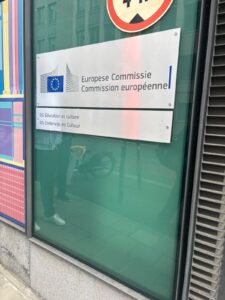
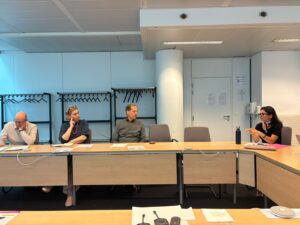
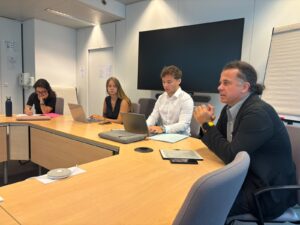
On 17 June 2026, following its General Assembly in Ghent, EASE held an institutional meeting with representatives of the European Education and Culture Executive Agency and the European Commission in Brussels.
The meeting brought together EASE members and staff with Sarah Lynch, Deputy Head of Unit for Sport at the European Commission, Matteo Zacchetti from the European Commission’s Sport Unit, and Jan Behrens from the European Commission’s Directorate-General for Employment, Social Affairs and Inclusion.
This exchange provided an important opportunity for EASE to carry forward the messages shared by its members during the General Assembly and to deepen discussions on several policy issues that are increasingly relevant for sport employers across Europe.
While the General Assembly had focused on EASE’s governance, projects, network and members’ national challenges, the Brussels meeting allowed EASE to further discuss specific European policy developments, including the implementation of the EU Pay Transparency Directive, future opportunities under the Support for Social Dialogue programme, and the need to give social partners a stronger role in European sport governance.
Recognising sport as a genuine economic sector
EASE members first presented several challenges faced by sport employers in their respective national contexts. These contributions confirmed that, despite differences between countries, sport employers across Europe are confronted with a number of shared structural issues.
The Sports Union of Slovenia highlighted concerns regarding professional qualifications and skills recognition in the sport sector. While coaches are generally required to hold formal qualifications, new questions are emerging around individuals offering sport or nutrition advice through social media without recognised credentials. Members also noted the growing use of artificial intelligence by coaches and the lack of clear guidance regarding its use and regulation.
The Dutch employers’ organisation WOS reported continued pressure linked to inflation and rising operating costs. It also underlined concerns regarding low wage levels in the sector, difficulties in attracting and retaining young workers, and the limited participation of employers in representative structures. Particular attention was given to volunteer-led organisations, which are increasingly expected to assume employer responsibilities without always having the appropriate support or expertise.
The Slovak Sport and Innovation Cluster stressed the lack of reliable data on employment in sport. Current national estimates may underestimate the real number of people working in the sector, limiting the visibility and recognition of sport as an economic activity. Members therefore called for a more harmonised European methodology to measure employment in sport and better assess its economic impact.
These national perspectives reinforced one of EASE’s central messages: sport should not only be recognised as a social, cultural or recreational activity. It must also be understood as a fully-fledged economic sector, with its own labour market, employment relations, skills needs and workforce development challenges.
Pay Transparency Directive: the need for sector-specific guidance
A key part of the meeting was dedicated to the implementation of the EU Pay Transparency Directive and the specific challenges it may raise for sport organisations.
EASE underlined that the sport sector has a particularly fragmented employment structure. A very large majority of sport organisations are small or micro-organisations, often with limited human resources capacity and without highly formalised salary structures. This reality creates practical challenges when implementing new obligations related to pay transparency, pay structures and reporting.
The complexity of remuneration systems in sport was also discussed. In many sport organisations, pay may include fixed salaries, performance bonuses, image rights, benefits in kind or other variable elements. These specific features can make it difficult to apply general transparency tools without adapting them to the realities of the sector.
EASE also highlighted that the concept of “work of equal value” may be particularly sensitive in sport, where many jobs have historically been structured around athletic performance, talent, sporting results and market visibility. Without proper guidance, there is a risk that certain functions, including administrative, support and managerial roles, may remain undervalued, especially when they are more often occupied by women.
To anticipate these challenges, EASE has already taken several initiatives. EASE Talk n°16 was dedicated entirely to the Pay Transparency Directive and benefited from the contribution of Samuel Engblom, Deputy Equality Ombudsman of Sweden and Chair of the Equinet cluster on the Directive. EASE has also contributed to European discussions on the development of practical tools and has continued to reflect on how sport employers can be supported in the implementation process.
The main message shared during the meeting was clear: generic implementation tools may not be sufficient for sport organisations. Sector-specific guidance, practical resources and capacity-building support will be essential to help sport employers comply effectively with the Directive while taking into account the specific structure of the sector.
Play FAIR-PAY: supporting sport employers through practical tools
In this context, EASE also presented its reflections around the Play FAIR-PAY initiative, submitted under the Citizens, Equality, Rights and Values programme.
The initiative aims to support sport employers and social partners in addressing pay transparency and equal pay issues through capacity-building activities, practical resources and tailored guidance.
For EASE, this type of project is essential to ensure that European legislation can be translated into concrete and realistic tools for sport organisations. Many clubs, federations and sport employers are willing to comply with new legal requirements but may lack the internal expertise, time or resources to do so without support.
By developing guidance adapted to the sport sector, Play FAIR-PAY would contribute both to better compliance and to a broader cultural change around equal pay, transparency and fairness in sport employment.
Strengthening social dialogue through capacity building
The meeting also focused on the development of social dialogue in sport, a long-standing strategic priority for EASE.
EASE recalled that effective social dialogue remains difficult to establish in many Member States because employer and worker representation in the sport sector is often fragmented, underdeveloped or absent. While sport employs hundreds of thousands of people across Europe, its representative structures remain weaker than in many other economic sectors.
For EASE, strengthening social dialogue in sport requires long-term capacity building. This means supporting the creation and development of national sport employer organisations, helping them provide services to their members, strengthening their legitimacy, and equipping them to engage in structured dialogue with workers’ representatives and public authorities.
This membership-based approach is at the core of EASE’s work. By supporting national employer organisations and connecting them at European level, EASE aims to build stronger representative structures able to address employment, skills, working conditions and labour market issues in the sport sector.
Support for Social Dialogue: an opportunity for sport employers
The exchange with Jan Behrens from the European Commission’s Directorate-General for Employment, Social Affairs and Inclusion also provided an opportunity to discuss the European programme Support for Social Dialogue.
This discussion helped clarify the eligibility conditions and potential opportunities for future applications in this field. For EASE, this programme could represent an important opportunity to further develop employer representation in sport and to support the structuring of social dialogue in countries where it remains weak or underdeveloped.
The meeting confirmed that the development of social dialogue in sport cannot be separated from the question of representation. In many countries, before meaningful social dialogue can take place, sport employers must first be organised, equipped and recognised as legitimate social partners.
This is why EASE will continue to explore how future European funding opportunities can support capacity-building activities, mapping exercises, national employer structures and stronger European cooperation.
No good governance in sport without social dialogue
Another important message raised during the meeting was that there can be no good governance in sport without social dialogue.
While social dialogue is widely recognised as a cornerstone of European governance in many economic sectors, employment-related issues still receive limited attention in European sport policy discussions. Debates on sport governance often focus on integrity, participation, inclusion, sustainability or competitiveness, but the role of employers, workers and social partners is not always sufficiently visible.
EASE therefore called for greater involvement of social partners in major European sport events and policy discussions, including the Erasmus+ Sport Info Day and the EU Sport Forum.
Sarah Lynch acknowledged this request and confirmed that the issue would be taken into consideration in future reflections.
EASE also recalled that the last time social partners were given a dedicated platform at the EU Sport Forum was in 2012, during the Cypriot Presidency of the Council of the European Union. Since then, despite the increasing professionalisation of the sector and the growing importance of employment-related challenges, such a platform has not been included in subsequent editions of the Forum.
For EASE, the involvement of employer and worker representatives is essential to ensure that European sport policy reflects the realities of the sector. Sport organisations are not only places of participation and performance. They are also workplaces, employers, economic actors and professional environments.
Three key messages for the future of European sport
The meeting confirmed a shared interest in strengthening the recognition of sport as a fully-fledged economic sector and in improving understanding of its labour market realities.
Three key messages emerged from the exchange.
First, sport is an economic sector in its own right. It has specific employment structures, workforce needs, regulatory challenges and economic realities that must be better recognised at European level.
Second, stronger social dialogue is essential for good governance and sustainable development in sport. Without structured employer and worker representation, it is difficult to address employment, skills, working conditions and sectoral transformation in a meaningful way.
Third, social partners should play a more prominent role in European discussions and decision-making processes affecting the sport sector. Their involvement would help ensure that European sport policy is not disconnected from the realities of those who work in, manage and sustain sport organisations every day.
Continuing the dialogue
EASE would like to thank Sarah Lynch, Matteo Zacchetti and Jan Behrens for their participation, openness and constructive contributions to the discussion.
The meeting represented an important step in EASE’s ongoing efforts to strengthen the voice of sport employers in Europe. It also confirmed the relevance of EASE’s work on employer representation, social dialogue, pay transparency, skills development and the recognition of sport as an economic sector.
Building on the messages shared by its members and the exchanges held with European institutions, EASE will continue to advocate for a more structured, inclusive and sustainable European sport sector — one in which sport employers and social partners are fully recognised as key actors in the future of sport.