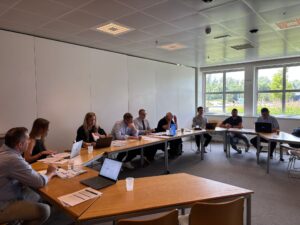
On 16 June 2026, EASE held its General Assembly at the premises of Sportwerk Vlaanderen in Ghent, bringing together members, staff and invited guests for an afternoon dedicated to governance, strategic reflection and exchange on the future of sport employers in Europe.
The meeting was opened by Laurent Martini, Executive Director of EASE, who welcomed the members participating both in person and online. He warmly thanked Sportwerk Vlaanderen for hosting the General Assembly in Ghent and underlined the importance of this annual gathering for the association.
This year’s General Assembly had a dual objective. On the one hand, it allowed EASE to address key statutory and governance matters, including the approval of revised by-laws, the activity report and the 2025 accounts. On the other hand, it provided a valuable opportunity for members to discuss EASE’s development, ongoing projects, European network and strategic priorities for the coming years.
A renewed governance framework for EASE
One of the major milestones of the General Assembly was the approval of the revised EASE by-laws, replacing the previous version adopted in 2009.
This update marks an important step in the modernisation of EASE’s governance framework. The revised text aims to clarify the association’s internal rules, better reflect its European dimension and provide a stronger basis for its future development.
Among the main amendments adopted, the membership category previously referred to as “Associated Members” has been renamed “Supporting Members”. This change provides a clearer description of the role of organisations that support EASE without holding the same status as full members.
The mandate of Executive Board members has also been extended from two to four years, starting with the next elections in 2027. This amendment aims to ensure greater stability within EASE’s governance and to allow the Executive Board to pursue longer-term priorities more effectively.
The revised by-laws also include clearer references to the European framework and to the fundamental values of the European Union, reaffirming EASE’s commitment to cooperation, social dialogue, inclusion and responsible governance in sport.
Looking back at an active year for EASE
Members then reviewed EASE’s 2025 Activity Report and accounts, highlighting a particularly active and important year for the association.
Throughout 2025, EASE continued to strengthen its visibility and positioning at European level. Four editions of the EASE Talks were organised, covering topics such as artificial intelligence, digital transformation, geopolitics, European institutions and the development of a stronger European dimension for sport employers.
EASE also participated in the European Parliament Stakeholders’ Dialogue on the role of EU policies in shaping the European Sport Model. This participation reflected the growing recognition of EASE as a credible stakeholder within the European sport ecosystem and confirmed the importance of bringing the perspective of sport employers into European policy discussions.
Another major milestone was the final conference of the BeST Inclusion project, held in Paris in April, which also marked the launch of EASE’s European mobility initiative. Through the Charting Europe project, EASE visited fifteen European countries across four tours between April and September. These visits allowed the association to expand its network, strengthen relationships with national sport stakeholders and promote key initiatives such as the BeST Inclusion project and the Social Charter for Sport Events.
The year concluded with EASE’s conference “Shaping the Future of European Sport”, held in Brussels at the Permanent Representation of Portugal to the European Union. The event brought together more than sixty representatives from the European sport ecosystem and focused on the future of social dialogue in sport and the importance of continued European support for the sector.
The 2025 accounts were presented and approved by the General Assembly.
Expanding EASE’s European network
The General Assembly also provided an opportunity to present an updated mapping of EASE’s European network.
This mapping exercise illustrated the growing number of organisations, institutions and stakeholders with whom EASE has established contacts or partnerships across Europe. It also demonstrated the progressive strengthening of EASE’s European presence and the importance of maintaining close cooperation with national employer organisations, sport federations, public authorities, European institutions and other relevant actors in the sport sector.
For EASE, this network is not only a matter of visibility. It is also a practical tool to better understand national realities, identify common challenges and build a stronger collective voice for sport employers at European level.
Updates on EASE’s current European projects
Members were then presented with updates on EASE’s main ongoing European projects: TechSportKit, SEMASC and YouthSportCV.
TechSportKit, coordinated by EASE, focuses on the impact of digitalisation, data and artificial intelligence on sport organisations and employment in the sector. The project has now entered its research phase, with a European survey currently being disseminated to collect evidence on digital practices, skills needs and training priorities across Europe. Members were encouraged to support the dissemination of the survey through their national networks in order to ensure that the perspective of sport employers is properly represented.
The SEMASC project continues its work on the socio-economic models of amateur sport clubs. The project aims to provide practical tools to help clubs better understand and strengthen their organisational and economic sustainability. EASE contributes to the project by ensuring that employment-related issues remain central to the project’s outputs.
The Assembly also received an update on YouthSportCV, coordinated by the Sports Federation Union of Catalonia. The project focuses on improving the employability of young people by helping them identify, assess and promote the skills acquired through sport participation and volunteering.
Together, these projects reflect EASE’s ambition to support sport employers in addressing some of the most important transformations currently affecting the sector: digitalisation, sustainability, employability and the development of new skills.
EASE Talk n°17: health and well-being at work in sport organisations
As part of the General Assembly, members also attended EASE Talk n°17, dedicated to the following question: how can sport employers improve health and well-being in their workplace?
The session benefited from the contributions of Nikolaus Kleemann, representing the Austrian Company Sport Federation, and Dirk Van Haelter, member of the Executive Committee of the European Federation for Company Sport.
The discussion explored how workplace well-being can be approached in a practical, accessible and realistic way by sport employers, including clubs, federations, studios and small sport organisations. The exchange highlighted that improving health at work does not necessarily require complex or costly programmes. It can start with simple and low-threshold initiatives, such as movement rituals, walking meetings, active breaks, workplace challenges, commuting habits, internal nudges or local partnerships.
For sport employers, the issue of health and well-being at work is not only a health topic. It is also an employer issue, an attractiveness issue and a collective performance issue. Supporting movement and well-being in the workplace can help reduce sedentary routines, strengthen employee engagement, improve retention and show that sport organisations apply internally the values they promote externally.
The publication of EASE Talk n°17 will follow in the coming weeks.
Common challenges for sport employers in 2026
A central part of the General Assembly was dedicated to an exchange between members on the main challenges currently facing sport employers in their respective countries.
Several common concerns emerged from the discussion, including economic pressure, inflation, labour shortages, skills development, digitalisation, administrative burden and the need for stronger recognition of sport as an economic sector.
Members shared national perspectives from France, Slovenia, the Netherlands, Finland, Italy and Slovakia. While national situations differ, the discussion showed that sport employers across Europe are facing many similar structural challenges.
In France, members highlighted the difficult economic context, marked by inflation and increasing operational costs. Rising transport and energy costs were identified as a growing burden for employers and workers, including professional athletes who are required to travel regularly.
In Slovenia, concerns were raised about qualification requirements in the sport sector, especially in relation to individuals providing sport or nutrition advice through digital platforms without recognised qualifications. Members also discussed the growing use of artificial intelligence by coaches and the need to reflect on appropriate frameworks.
In the Netherlands, members reported challenges linked to inflation, low wage levels in the sport sector, difficulties in attracting and retaining young workers, and the need to better support volunteer-based organisations that are increasingly required to assume employer responsibilities.
The Finnish perspective underlined concerns regarding the growing complexity of European regulation and the administrative burden this may create for employers.
In Italy, recent legislative reforms formally recognising sport workers were presented as an important step forward, while the need to further develop effective social dialogue structures between employers and workers was also highlighted.
In Slovakia, members stressed the lack of reliable and comparable data on employment in sport. The discussion underlined the need for a more harmonised European methodology to measure employment and the economic impact of the sport sector. Stronger evidence and statistics would support the recognition of sport as a genuine economic sector and strengthen its representation before public authorities and European institutions.
Overall, members agreed on the importance of strengthening the recognition of sport as an economic sector, improving the quality of employment data, supporting skills development and ensuring that sport employers are adequately represented at both national and European level.
Social dialogue as a strategic priority
The General Assembly also included a presentation of EASE’s ongoing study on social dialogue in sport in Europe.
This study aims to provide a comprehensive overview of the current state of social dialogue in the sector, looking at both the European institutional framework and previous experiences of social dialogue in sport. It also explores the added value that social dialogue can bring to employers, workers and organisations, while identifying the structural obstacles that continue to limit its development.
One of the main findings highlighted during the meeting is that sport employers remain insufficiently organised and represented in many European countries. Strengthening employer representation at national level therefore appears as a necessary precondition for developing stronger European social dialogue structures in the future.
In this context, EASE presented its intention to further develop the BRIDGES initiative, which aims to support the creation and development of sport employer organisations in countries where such structures remain absent or underdeveloped. This initiative is expected to be linked to future European funding opportunities dedicated to social dialogue.
As part of the study, EASE has also developed a series of country profiles mapping social dialogue structures and key stakeholders in several European countries. These resources will soon be made available to members and will support future cooperation and knowledge-sharing activities.
Preparing future institutional exchanges
The General Assembly also allowed members and staff to prepare the institutional meeting scheduled the following day in Brussels with the European Education and Culture Executive Agency.
This preparation helped align messages, priorities and expectations ahead of the exchange, particularly on issues linked to European projects, social dialogue, employment-related challenges and the role of sport employers in European policy discussions.
A collective step forward for EASE
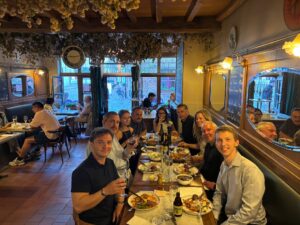
In his closing remarks, Laurent Martini thanked all members, staff and guests for their participation, contributions and constructive spirit throughout the General Assembly.
The 2026 General Assembly confirmed EASE’s continued growth as a European network representing sport employers. It also demonstrated the importance of bringing members together to combine governance, project development, national perspectives and European advocacy.
By sharing experiences, identifying common challenges and aligning future priorities, EASE members reaffirmed their commitment to strengthening the voice of sport employers in Europe and contributing to a more structured, inclusive and sustainable sport sector.